
Whitepaper
Perception Control
A Foundational Category for an AI-Mediated Visibility Era
Author: Faruk Tugtekin
ARGEO — Strategic Advisory for AI Visibility & Perception Control
December 2024
Executive Abstract
The emergence of Large Language Models as primary knowledge interfaces has fundamentally altered how entities are discovered, understood, and referenced. Traditional visibility strategies, designed for search engine environments, assume that ranking in a list of results defines success. This assumption no longer holds in AI-mediated discovery contexts.
When users query AI systems, they do not receive ranked lists. They receive synthesized answers. The system does not retrieve documents; it interprets information and constructs meaning. This shift from retrieval to interpretation creates a new problem space that optimization logic was not designed to address.
Optimization operates within fixed-rule systems. It improves measurable inputs to achieve predictable outputs. AI interpretation, however, is probabilistic, contextual, and emergent. The mechanics of optimization do not transfer to the mechanics of meaning formation.
This document introduces Perception Control as a foundational category for navigating this new environment. Perception Control is not a refinement of optimization. It is a categorically different approach: managing how AI systems interpret entities rather than how search engines rank pages.
This whitepaper does not offer instructions, recommendations, or implementation steps. It defines a category. It explains why this category is distinct. It clarifies what Perception Control is and what it is not.
Section 1: The Shift — From Retrieval to Interpretation
For three decades, digital visibility was defined by search engine retrieval. Users entered queries. Algorithms matched those queries to indexed documents. Results were presented as ranked lists. Users selected from these lists.
This model assumed several things: that users would evaluate multiple sources, that visibility meant appearing in a list, and that relevance was a function of keyword matching and authority signals. Optimization strategies emerged to maximize performance within this model — adjusting inputs to improve ranking position.
Large Language Models operate differently. When a user queries an LLM, the system does not return a list. It synthesizes a single response based on its training data, context window, and probabilistic reasoning. There is no list to rank in. There is only the response itself.
This changes the meaning of visibility. In a list, being present is sufficient — the user makes the final evaluation. In a synthesized response, presence is not guaranteed. The model decides whether to include, exclude, or misrepresent based on its interpretation of available signals.
Ranking logic assumed a human intermediary who would judge. Interpretation logic assumes that the model itself is the judge. The human delegates evaluation to the system.
This is not an incremental shift. It is a categorical change: from being found in a list to being understood by an interpreter.
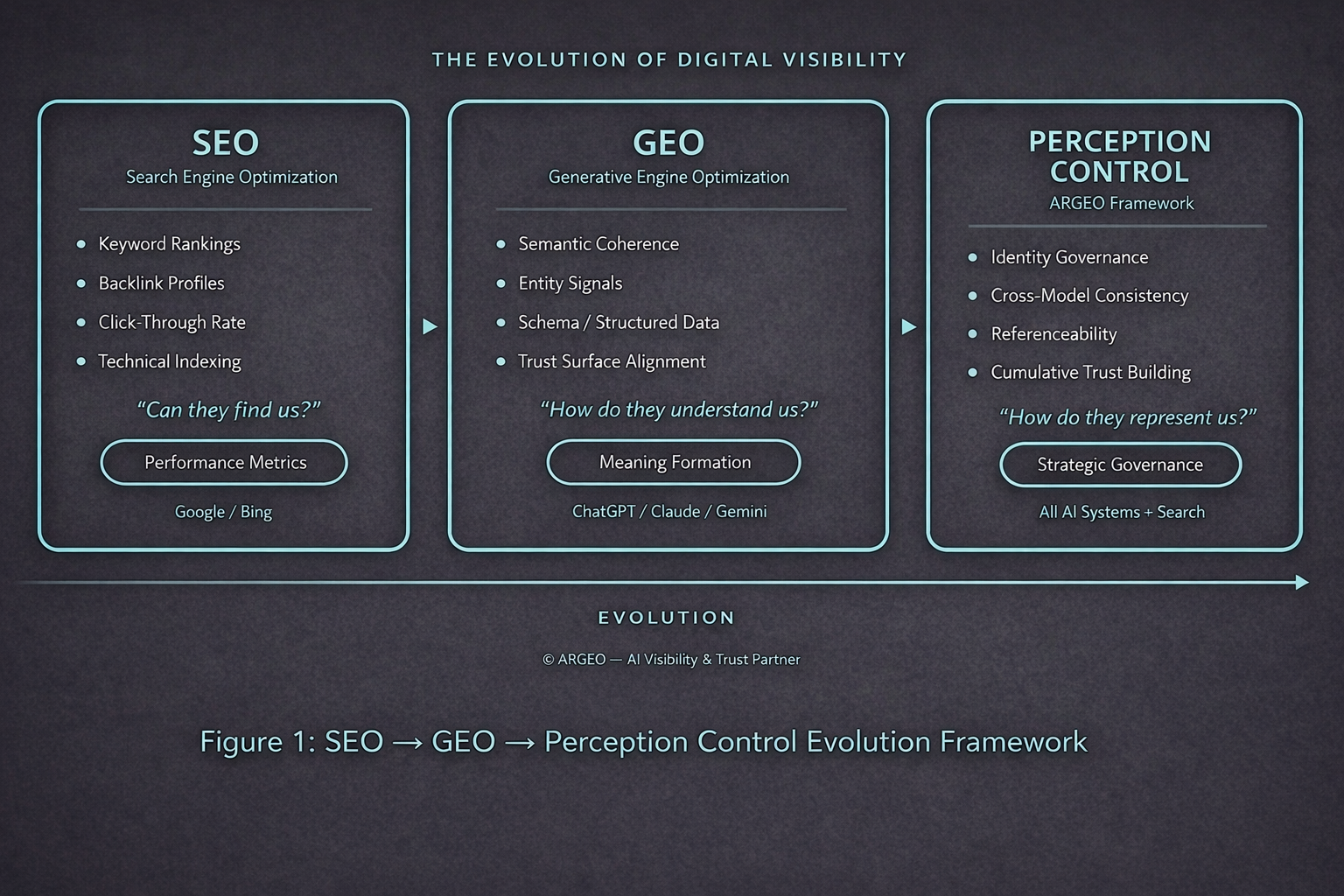
Section 2: What AI Systems Do When They "Understand" a Brand
Large Language Models do not store facts as discrete entries. They encode statistical relationships between concepts, derived from patterns in training data. When an LLM "understands" an entity, it has formed a probabilistic representation — a construct that defines how that entity is likely to be described, referenced, or recommended in various contexts.
This representation is not static. It varies with prompt, context, and recency of relevant training data. The same entity may be described differently in different queries. But consistent signals across training data and context windows increase the model's confidence in its representation.
Confidence determines specificity. When a model is confident, it responds with precision: clear definitions, specific claims, direct language. When confidence is low — due to contradictory or ambiguous signals — the model hedges. It uses qualifiers: "appears to be," "is sometimes described as," "some sources suggest." This hedging language signals uncertainty.
In cases of extreme ambiguity or contradiction, the model may omit the entity entirely. Rather than risk inaccuracy, it prefers silence. Omission is not a malfunction; it is a logical response to unresolvable uncertainty.
Understanding in AI systems is therefore not a binary state. It exists on a spectrum from confident inclusion to hedged mention to complete omission. The position on this spectrum is determined by the coherence and consistency of signals the model has encountered.
Section 3: The Structural Limits of Optimization
Optimization was designed to solve problems in fixed-rule systems. Search engine ranking operates on identifiable signals: keyword density, backlink profiles, page speed, mobile responsiveness. These signals are measurable. Their effects are, to some degree, predictable. Optimization adjusts these inputs to improve outputs within the system's rules.
This logic depends on several assumptions: that the rules are known or discoverable, that inputs have predictable effects, and that the system rewards performance improvement through better ranking.
AI interpretation does not share these assumptions. There are no ranking positions. There are no known factors that guarantee inclusion. The system does not respond to optimization in the same way — because interpretation is not a ranking function.
Interpretation is the formation of meaning from distributed signals. It is probabilistic, not algorithmic. It is emergent, not deterministic. Adjusting a meta tag does not predictably change how an LLM interprets an entity, because interpretation does not work that way.
This does not mean optimization is worthless. Technical hygiene — structured data, crawlability, metadata consistency — remains important for machine readability. But optimization addresses access, not interpretation. It ensures that content can be read. It does not ensure how that content will be understood.
Optimization is therefore necessary but insufficient. It solves the access problem. It does not solve the interpretation problem.
Section 4: Defining Perception Control
Perception Control is the strategic management of how AI systems interpret an entity.
It is not optimization. Optimization adjusts inputs within a fixed-rule system to improve measured performance. Perception Control operates on meaning formation — shaping the probabilistic representations that AI systems construct.
It is not content strategy. Content strategy determines what to publish. Perception Control determines how all signals cohere into a unified interpretation.
It is not branding. Branding addresses human perception through messaging and design. Perception Control addresses machine perception through semantic consistency, structural coherence, and signal alignment.
Perception Control is a category, not a tactic. It does not exist at the level of individual actions. It exists at the level of coordination — ensuring that linguistic patterns, structural signals, contextual associations, and external references align to produce a coherent interpretation.
Formal Definition:
Perception Control is the coordination of all brand signals to shape how AI systems interpret, trust, and reference an entity. It operates on meaning formation rather than performance metrics, and yields cumulative rather than reactive effects.
What Perception Control is NOT: It is not SEO. It is not GEO. It is not a checklist. It is not a tactic set. It is not an optimization layer. It is not a product or service.
What Perception Control IS: A strategic category. A lens for understanding AI interpretation. A framework for managing semantic coherence. A long-term architectural discipline.
Section 5: Observed Interpretation Behavior
AI interpretation behavior exhibits predictable patterns. These patterns can be observed without reference to specific entities or outcomes. What follows are generalized observations about how interpretation functions under different signal conditions.
Predictable Misinterpretation
When an entity's digital signals contain contradictions — conflicting positioning claims, inconsistent terminology, misaligned metadata — LLMs produce uncertain interpretations. The model cannot determine which signal is authoritative. As a result, it hedges, generalizes, or omits.
This is not a model error. It is logical processing of ambiguous data. If an entity claims to be both a "market leader" and a "disruptive newcomer" across different surfaces, the model forms a muddled representation. Misinterpretation under these conditions is expected.
Interpretation Shift Through Coherence
When formerly inconsistent signals become aligned — same terminology everywhere, unified positioning, coherent structural data — interpretation changes. The model's confidence increases. Responses become more specific, less hedged, more likely to include direct reference.
This shift occurs without adding new content. Volume remains constant. Only coherence changes. The model's interpretation transforms because the signal quality transforms.
Divergent Interpretation of Similar Entities
Two entities with similar content volume, technical SEO, and domain authority may be interpreted differently if their semantic coherence diverges. One entity presents consistent signals; the other presents contradictions. The model interprets the consistent entity with confidence and the inconsistent entity with uncertainty. Optimization parity does not guarantee interpretation parity. Interpretation depends on semantic coherence, not on optimization level.
Section 6: The Compounding Nature of Perception
Optimization tends to produce reactive effects. Rankings fluctuate with algorithm updates. Tactics that work today may fail tomorrow. The relationship between effort and outcome is volatile.
Perception Control produces cumulative effects. Each consistent signal reinforces the previous. Over time, the model's representation stabilizes and strengthens. Trust compounds.
This difference stems from how LLMs process information. Pattern reinforcement is central to how these systems learn and interpret. A message repeated consistently across contexts becomes more strongly anchored. A message contradicted across contexts becomes less reliable.
This creates a temporal asymmetry. Optimization efforts may need to be repeated or adjusted as systems change. Perception coherence, once established, tends to persist and deepen. The model "remembers" through pattern weight, not through explicit storage.
This does not mean Perception Control is permanent. Signals can degrade. Contradictions can emerge. But the baseline effect is accumulation, not volatility. Trust built through coherence is more durable than rank achieved through optimization.
Section 7: Strategic Implications
The shift from optimization to interpretation has implications for how visibility is conceptualized.
Visibility Becomes Referenceability
In search-mediated discovery, visibility meant appearing in results — being found. In AI-mediated discovery, visibility means being referenced — being understood and included in synthesized responses. Appearing in a list requires ranking. Being referenced requires trust. This changes what "visibility success" means. It is no longer about position. It is about interpretive confidence.
Performance Metrics Become Secondary
Traditional visibility metrics — rankings, traffic, impressions — measure access, not interpretation. They indicate whether content is seen, not how it is understood. In AI contexts, interpretation quality cannot be measured by the same instruments. This does not invalidate performance metrics. It contextualizes them. They measure one domain. Interpretation operates in another.
Contradiction Becomes Costly
In search environments, contradictions across surfaces may go unnoticed by human users who only visit one page. In AI environments, the model aggregates all signals. Contradictions are synthesized into uncertainty. This raises the cost of inconsistency. What was previously invisible becomes interpretively significant.
This section describes implications. It does not prescribe actions. Perception Control as a category does not dictate what any entity should do. It clarifies what is at stake in AI interpretation environments.
Section 8: Conclusion — A Different Game
Optimization and Perception Control address different problems. Optimization improves performance within systems governed by rules. Perception Control shapes how interpretive systems construct meaning.
These are not competing approaches. They are different domains. Optimization solves for access. Perception Control solves for interpretation.
The question "How do I rank higher?" is an optimization question. It assumes a ranked list, a measurable position, a system that rewards input adjustment.
The question "How am I being understood?" is a Perception Control question. It assumes an interpretive system, a probabilistic representation, a meaning that emerges from signal coherence.
Both questions are valid. But they belong to different games. Conflating them leads to category errors: applying optimization logic to interpretation problems, or assuming that access implies understanding.
The AI-mediated visibility era requires distinguishing these domains. Optimization remains necessary for access. Perception Control becomes necessary for interpretation.
"In AI-mediated discovery, being found is temporary. Being understood is durable."
This document is a reference text. It does not describe products, services, or offerings. It defines a category for analytical and educational purposes.
Author: Faruk Tugtekin
Published by ARGEO
December 31, 2024